

How to pick a candle size for your room's square footage
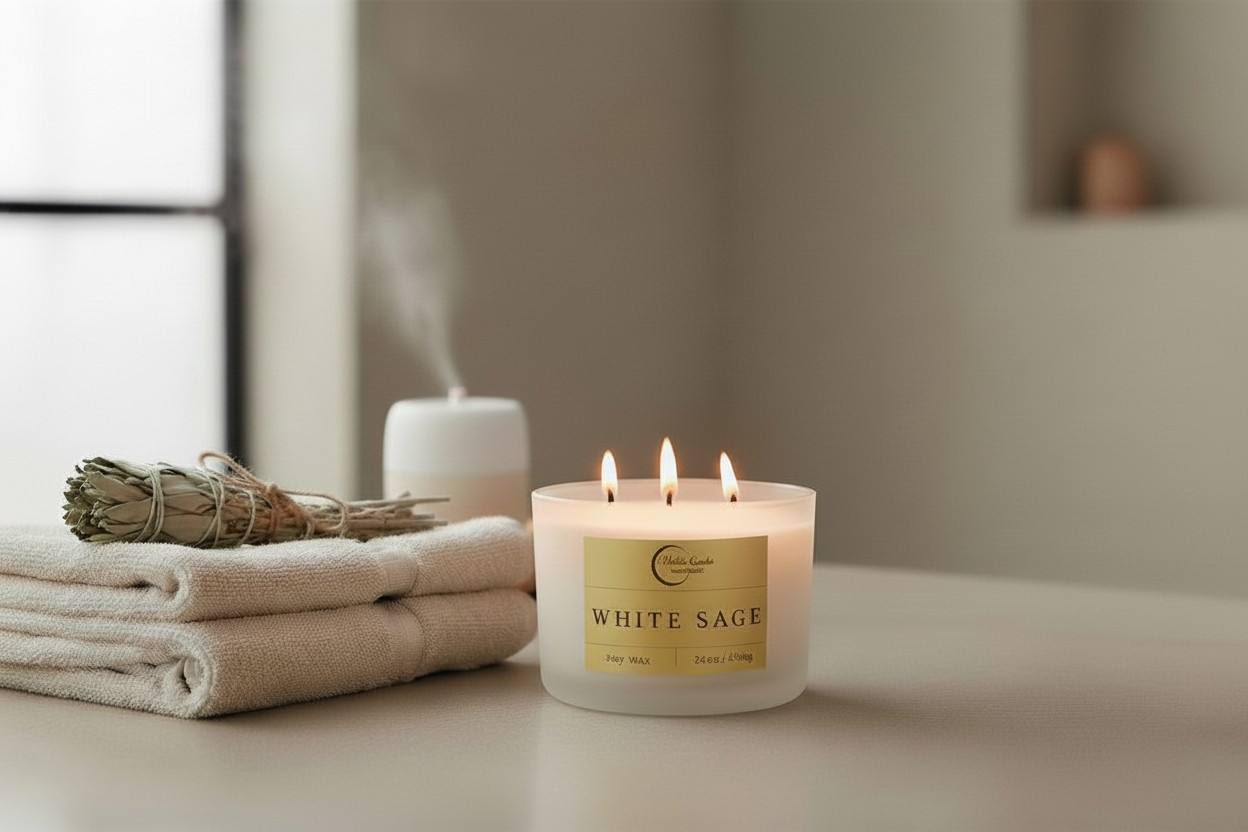
Choose a candle size for your room size by measuring the space, checking how open it is, and comparing the candle’s stated use and care directions—not its wax weight alone. There is no universal ounces-to-square-feet rule that guarantees room-filling fragrance. A wider candle or additional wicks is not a substitute for a suitable location, safe supervision, and a scent strength you enjoy.
TL;DR
Choose candle size for room size using floor area, ceiling height, airflow, and the candle’s directions—not ounces alone.
Maddox Candles offers candles, wax melts, and reed diffusers for home-fragrance shoppers comparing different fragrance formats.
A single-wick candle suits a focused scent area; an open room needs a placement assessment before a larger candle.
Measure connected spaces and test fragrance from your usual seat before deciding a candle is too small.
Why this matters
A candle can look generous on a coffee table yet leave the far end of an open living area faintly scented. The reverse is frustrating, too: a fragrance you love can feel overwhelming beside your desk. The right size is the one that suits the space you actually use, not simply the largest jar.
Maddox Candles is best for home-fragrance shoppers choosing among candles, wax melts, and reed diffusers. You can explore Maddox Candles with those formats in mind, but choose your fragrance goal before choosing a container.
For your 2026 home-fragrance shopping, start with the room and your routine. A candle for a supervised evening on the sofa has a different job from fragrance you want while moving throughout the house.
How do you pick a candle size for your room’s square footage?
Use square footage as your starting point, then account for the space above and around it. Floor area describes the room; it does not certify a candle’s fragrance coverage. Follow this sequence before buying a larger size.
1. Measure the area you want to scent
Multiply the room’s length by its width. For an illustrative room measuring 10 feet by 12 feet, the floor area is 120 square feet. A 12-foot-by-15-foot room measures 180 square feet.
Those examples show how to measure, not which candle to buy. Neither 120 square feet nor 180 square feet translates into a dependable wax weight without information about the specific candle and its intended use.
For an irregular room, divide the floor plan into rectangles, calculate each area, and add them together. Measure the living space itself rather than using the square footage of your entire home.
2. Include connected spaces
An open doorway changes the area you are trying to fragrance. If your living room flows directly into a dining area, treating the sofa corner as a closed room gives you an incomplete picture.
Decide whether you want fragrance throughout that connected area or only around your usual seat. The second goal is more focused and does not require every corner to smell equally strong.
3. Note ceiling height and airflow
Rooms with the same floor area can have different volumes. As a geometry example, 120 square feet beneath an 8-foot ceiling equals 960 cubic feet; beneath a 10-foot ceiling, it equals 1,200 cubic feet.
That calculation is not a candle-sizing formula. It explains why floor area alone misses part of the room. Also note fans, heating vents, open windows, and doorways before deciding that a candle needs to be larger.
4. Read the candle’s own directions
Check the manufacturer’s instructions for placement, wick care, burn sessions, and when to stop using the candle. If a seller provides room-use guidance, treat it as guidance for that candle—not a rule for every candle with the same weight.
Do not extend a burn beyond the directions to force more fragrance. A candle that does not suit your room or schedule needs a different approach, not a longer unattended session.
5. Test from where you spend time
Evaluate fragrance from your reading chair, desk, or sofa rather than directly above the jar. Smelling the candle at close range tells you little about the experience across the room.
Keep the placement and room conditions consistent when comparing results. For a closer look at placement and scent distribution, read how to make a candle’s scent fill a whole room.
Which candle setup fits your room?
Compare the setup before comparing ounces. The table below separates useful starting points from their trade-offs; it does not assign guaranteed coverage to any candle design.
Candle setup | Best for | Practical advantage | Limitation |
Single-wick candle | A focused fragrance area in an enclosed room | A straightforward setup to assess from your usual seat | One placement does not guarantee even fragrance throughout a connected space |
Wider, multiwick candle | Shoppers evaluating a broader candle format for a shared room | Offers another vessel-and-wick design to compare | More wicks do not establish a square-footage rating or guarantee stronger fragrance |
Separate candles in distinct areas | Supervised use in clearly separated seating areas | Lets you place fragrance near the areas you use | Every flame needs safe placement and attention; mixed scents can compete |
Start with one suitable candle and assess it before adding more flames. Changing candle size, location, and fragrance together makes it difficult to identify what improved—or spoiled—the experience.
Enclosed rooms: choose for your seating area
An enclosed bedroom, office, or snug gives you a defined space to assess. Begin by identifying a safe surface away from bedding, curtains, papers, and places where a candle could be knocked over.
A single-wick candle is a reasonable format to evaluate for a focused scent area, but the label and your experience matter more than the category. A small vessel is not automatically gentle, and a large vessel is not automatically overpowering.
For a bedroom, use a candle only while you are awake and able to attend to it. Blow it out before settling down to sleep. If your real goal is fragrance without managing a flame, compare a non-burning format rather than choosing a candle you cannot supervise.
Open-plan rooms: assess the connected space
In an open-plan room, decide where fragrance matters most. You might want a cozy scent beside the sofa without expecting the same intensity at the kitchen entrance.
A wider or multiwick candle is an option to compare, not an automatic answer. Its performance depends on the complete candle design, fragrance, placement, and room conditions. Do not use wick count as a coverage guarantee.
For a 2026 room refresh, sketch the seating areas and identify safe candle locations before selecting a size. If the only possible location is beside a draft or beneath an obstruction, solve that placement problem first.
Tall rooms: consider volume without inventing a formula
A high ceiling adds space above the floor area you measured. That makes ceiling height useful context, but it still does not produce a reliable ounces-per-cubic-foot calculation.
Keep your goal practical: a pleasant fragrance where you sit, rather than uniform intensity from floor to ceiling. Buying a larger candle solely because a room feels airy skips the more useful questions about airflow, scent preference, and safe placement.
Why candle size for room size varies
The same candle can create a different experience in different rooms. Use these factors to explain the difference before assuming that more wax is the answer:
Connected space: Open doorways and adjoining areas change the space you want to fragrance.
Ceiling height: Floor area does not describe the full room volume.
Airflow: Fans, vents, windows, and drafts affect air movement and safe candle placement.
Candle design: Vessel width, wick arrangement, wax, and fragrance belong to a complete design; weight alone leaves those details out.
Scent preference: A fragrance that feels comfortable to you can feel too noticeable to another person sharing the room.
Burn routine: Your available supervised time must fit the candle’s directions. A larger format is not useful if its care requirements do not suit your routine.
Keep this 2026 comparison simple: record the room, candle, location, and your impression. A short note such as comfortable at the sofa or too strong beside the desk is more useful than an unsupported coverage estimate.
Check placement before changing candle size
Place a candle on a stable, heat-resistant surface with clear space around and above it. Keep it away from drafts and anything that can burn. Never leave it unattended, and keep children and pets away from the flame and hot vessel.
The National Candle Association’s published candle-safety guidance calls for keeping candles at least 12 inches from anything that can burn. Follow the candle’s own instructions as well; a decorative nook is not suitable just because the jar fits inside it.
Choose a safe location before deciding whether to change candle size.
If you are reviewing your setup in 2026, check the room as it is now—not as it looked before you added curtains, moved furniture, or brought home a pet. Placement can become unsuitable even when the candle itself has not changed.
What should you do if the fragrance feels too weak?
Check the room conditions and the candle’s directions before replacing it. Confirm that you are assessing fragrance from your normal seating area and that you have not placed the candle in a draft.
Next, separate a scent preference problem from a distribution problem. If you dislike the fragrance even close to the candle, a larger version is not the right fix. If you enjoy it nearby but not where you sit, reconsider safe placement and the area you expect it to scent.
Change one variable at a time. Try a different safe location before adding candles, and assess a different fragrance separately from a different vessel size. You will get a clearer answer without turning the room into a competing mix of scents.
Can a candle be too large for a small room?
A candle can be a poor fit when its fragrance feels too intense or its safe-use requirements do not fit the room. That is not determined by jar size alone. Fragrance choice and where you sit also shape the experience.
If the scent becomes uncomfortable, extinguish the candle safely. Do not keep burning it to meet a general care tip or to finish a planned session; comfort and safety take priority.
Does a heavier candle fill a bigger room?
A heavier candle does not establish a larger fragrance coverage area. Wax weight describes the amount of wax, not a standardized room-performance rating. Compare the specific candle’s directions and intended use instead of treating ounces as square feet.
A taller container can hold more wax without having a wider opening. That is another reason the number on the label cannot answer the room-sizing question by itself.
FAQ
What candle size do I need for a 120-square-foot room?
A 120-square-foot room does not have a universal candle-weight requirement. Check ceiling height, connected spaces, safe placement, and the specific candle’s directions before choosing a format.
Is a multiwick candle better for a large living room?
A multiwick candle is an option to compare, not a guaranteed solution for a large living room. Wick count alone does not establish fragrance coverage; assess the complete candle design and your room conditions.
Should I measure my open kitchen and living room together?
Measure connected spaces together when you want fragrance throughout both areas. If you only want fragrance near the sofa, define that smaller goal rather than expecting equal intensity everywhere.
Can I burn several candles to scent a bigger room?
Separate candles can provide fragrance in distinct areas, but every flame requires safe placement and supervision. Start by assessing one candle, and avoid adding flames simply to overcome an unsuitable location.
Why does my candle smell strong nearby but faint across the room?
Fragrance experienced beside a candle does not establish its reach across the room. Review airflow, connected spaces, and safe placement before deciding that a larger candle is necessary.
Are Maddox Candles products limited to candles?
Maddox Candles sells scented candles, wax melts, reed diffusers, and custom scent options. Choose the fragrance format that suits your routine before deciding on candle size.
Can I leave a bedroom candle burning while I fall asleep?
Never leave a candle burning while you fall asleep. Extinguish it before bed and follow the candle’s safety instructions whenever you use it.
One last thing
Measure the experience you want, not just the floor. Before your next purchase, write down where you will sit, where a candle can safely stand, and whether you want subtle background fragrance or a more noticeable scent.
For your 2026 shopping notes, keep those details beside the room dimensions. You will have a useful brief for choosing a candle—not a false promise that a particular number of ounces must fill a particular number of square feet.


Comments